
Is Rooftop Solar Enough for Your Industry or Should You Consider Ground-Mounted Solar?
 TestAdmin
 You’ve done the electricity bill math. You’ve spoken to a few solar vendors. You’ve more or less decided that solar makes sense for your facility. And then someone asks: “But should you go rooftop or ground-mounted?”
For most homeowners, that question barely exists; the roof is the only option. But for industries with large land parcels, sprawling factory campuses, or energy demands that dwarf what their roof can accommodate, this is one of the most consequential decisions in the entire solar journey. Get it right, and your plant performs optimally for 25 years. Get it wrong, and you’ll spend the next decade wishing you’d thought it through more carefully.
Let’s work through this properly.
Why the Question Matters More for Industries Than Anyone Else
A residential solar system might be 5–10 kW. A mid-sized industrial facility could need 500 kW, 1 MW, or more to meaningfully offset its consumption. At that scale, the physical deployment of the system, where it goes, how it’s structured, how it interacts with your operations, has real engineering and financial consequences.
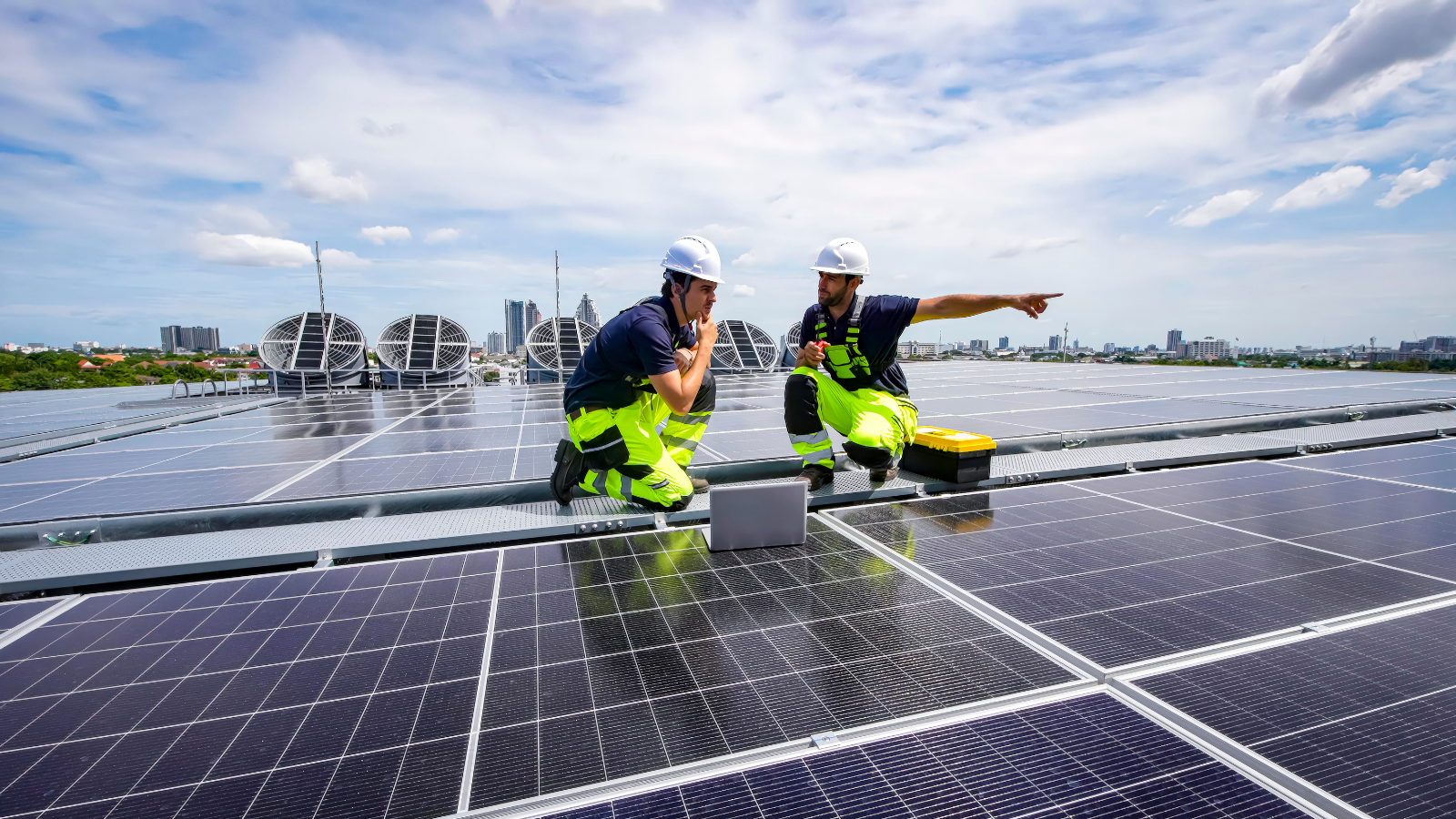
Rooftop solar for industries is the default starting point for most facilities, and rightly so. You’re using space that already exists, you’re not consuming land that could have other uses, and the proximity to your main consumption point reduces transmission losses. But “the roof” is not a blank canvas. Industrial rooftops come with constraints that residential ones don’t, and understanding those constraints is the first thing any credible Solar EPC contractor in India will do before recommending a system.
Ground-mounted solar plants, on the other hand, offer a different set of trade-offs: more flexibility in system orientation, no structural dependency on an existing building, and the ability to scale without being limited by roof geometry. But they require land, civil work, and a more complex installation process.
Neither option is universally better. The right answer depends on your facility.
The Case for Rooftop Solar: When It Works Well
For a large number of industries, particularly manufacturers and processing units with large, unobstructed factory roofs, rooftop solar is not just “enough.” It’s the optimal solution.
Here’s what makes a facility a strong rooftop solar candidate:
Large, structurally sound roof area. Industrial sheds, warehouses, and manufacturing facilities often have roof spans of several thousand square metres. Even after accounting for water tanks, HVAC equipment, and skylights, there’s typically enough clear space to mount a substantial system. A rough rule of thumb: 1 kW of solar capacity requires approximately 10 square metres of shadow-free roof area. So a 10,000 sq. m. roof could theoretically support a 500–600 kW system, significant for many mid-sized facilities.
Roof facing and pitch. South-facing roofs with a pitch of 10–15 degrees are ideal in India. Many industrial shed roofs have a naturally favourable pitch. If your roof faces east-west (as many do), systems can still be designed to capture high generation through split-string configurations.
Avoiding land costs and complications. In industrial areas of Maharashtra and other dense manufacturing belts, spare land is either scarce, expensive, or earmarked for expansion. Using the roof means your ground footprint stays productive for parking, storage, future construction, or operations.
Net metering eligibility. Most state DISCOMs permit net metering for rooftop systems up to certain capacities. If your plant qualifies, any surplus generation is credited against future bills, improving your returns without additional capital expenditure.
What most people don’t realise is that rooftop installations in industrial settings also offer a secondary advantage: the panels shade the roof, reducing heat absorption by the building, which in turn reduces air-conditioning loads. In hot climates like Maharashtra, this can meaningfully contribute to overall energy savings beyond the direct power generation.
When Rooftop Solar Isn’t Enough: The Honest Assessment
Rooftop solar has limits, and for certain industries, those limits matter.
Structural constraints. Older industrial buildings, particularly pre-engineered steel structures with light-gauge roofing, may not be able to bear the additional dead load of a solar mounting system without structural reinforcement. Before any system is designed, a structural engineer must assess the roof. If the cost of reinforcement is high relative to the system value, it can shift the economics in favour of a ground-mounted alternative.
Insufficient roof area for your energy target. If your industry runs energy-intensive operations, say, a continuous casting plant, a large cold storage unit, or a chemical processing facility, your consumption may simply exceed what your roof can generate. A 100,000 sq. ft. factory operating heavy machinery at an 80% load factor may need 2–3 MW of solar to achieve meaningful bill reductions. Most industrial roofs can’t comfortably accommodate that.
Shading from adjacent structures. In clustered industrial estates, neighbouring buildings, chimneys, and overhead infrastructure can cast shadows that significantly cut generation. Shadow analysis (using tools like PVsyst or Helioscope) is a non-negotiable step in industrial solar solution design, and sometimes the analysis reveals that the roof simply doesn’t receive enough unobstructed sunlight to justify the investment.
Complex roof geometry. If your facility has multiple roof sections at different heights, orientations, or slopes, system design becomes significantly more complex and potentially more expensive than a clean ground-mounted layout.
Ground-Mounted Solar: The Full Picture
A ground-mounted solar plant is exactly what it sounds like: a solar array installed on a structure anchored into the ground, typically on open land adjacent to or within your industrial facility.
The advantages are real and worth understanding clearly.
Optimal tilt and orientation. When you’re not constrained by an existing building’s orientation, your EPC engineer can design the mounting structure at the precise tilt angle that maximises annual energy yield for your specific latitude. For most of India, that’s between 10 and 20 degrees facing south. This can result in 5–10% higher generation per kW compared to a compromised rooftop installation.
Easier maintenance access. Ground-level systems are safer and cheaper to inspect, clean, and maintain over the system’s 25-year life. This is often overlooked during the initial investment decision but adds up significantly in O&M costs over time.
Scalability. Ground-mounted systems can be expanded in future phases more easily than rooftop ones. If your energy needs grow with your business, adding rows of panels on open land is considerably more straightforward than adding capacity to a roof with limited remaining space.
No structural dependency. The performance and longevity of a ground-mounted system aren’t tied to the condition of a building’s roof. There’s no risk of having to temporarily dismantle solar panels because your roof needs repair, which happens more often than industries anticipate.
The trade-offs are equally worth acknowledging. Ground-mounted systems require dedicated land. Civil work, foundation design, cable trenching, and boundary fencing add to the project cost and timeline. And depending on your land classification, there may be regulatory clearances to navigate.
Solar System Capacity Planning: The Deciding Framework
This is really the heart of the decision, and it’s what separates good solar system capacity planning from a superficial site visit.
A proper capacity planning exercise should answer three questions before any recommendation is made:
What is your actual energy demand profile? Not just your total monthly units, but when you consume power, which shifts, which machines, which seasons. A system sized to your average annual usage may significantly underperform during peak summer months and oversupply during quieter periods.
How much of that demand can your roof realistically support? After structural assessment, shadow analysis, and roof area calculation, what’s the maximum viable rooftop capacity? If that number covers 70% or more of your target offset, the rooftop may be sufficient. If it covers 40%, you have a gap to fill.
Do you have land, and what does it cost the business to deploy solar on it? Available land with no better competing use is a compelling argument for ground-mounting. Land that would otherwise support operations, parking, or future construction requires a more careful cost-benefit analysis.
In our experience, the most effective industrial solar solutions for large energy users often combine a rooftop system that maximises the value of the existing structure with a ground-mounted array that fills the generation gap to reach the target offset. This hybrid approach is increasingly common among serious industrial solar adopters.
What Your Solar EPC Contractor Should Be Doing
If you’re evaluating solar and a contractor hasn’t raised this question or has defaulted to “we’ll just do rooftop” without a proper site assessment, that’s worth noting.
A competent Solar EPC contractor in India working with industrial clients should conduct a full site feasibility study before proposing any system. That means structural assessment of your roof, shadow analysis using simulation software, load data analysis, land survey if relevant, and a financial model comparing rooftop-only, ground-mounted-only, and hybrid configurations under both CAPEX and OPEX financing.
That’s not a sales pitch, that’s engineering diligence. And it’s what makes the difference between a solar plant that looks good on paper and one that actually performs.
The Bottom Line
Rooftop solar is the right starting point for most industries, and for many, it’s entirely sufficient. But “sufficient” should be the output of analysis, not the assumption you begin with.
If you’re operating a large facility with significant energy loads, the question of rooftop versus ground-mounted solar deserves a proper answer, one grounded in your specific roof conditions, land availability, consumption profile, and financial objectives. The worst outcome is a system that under-delivers because this decision was made by default rather than design.
At Visol India, every industrial solar engagement begins with exactly this assessment: a detailed site feasibility study that tells you not just whether solar makes sense, but which configuration will deliver the best return for your specific facility. It’s free, it’s thorough, and it changes the quality of every conversation that follows.
Want to know how much of your facility’s energy needs can be met by rooftop solar, and whether a ground-mounted system makes sense for your site? Request a free feasibility study from Visol India and get clarity before you commit.
Recommended Posts

How Solar EPC Companies Design Solar Plants for Large Industries
27th March 2026
How Industrial Solar Power Supports India’s Renewable Energy Goals
17th February 2026
How Much Can Industries Save with Solar Power? A Cost & ROI Analysis
17th February 2026