Rooftop Solar vs. Ground-Mounted Solar: Which Is Better for Your Industry?
 TestAdmin
 Your electricity bill arrives every month like an unwelcome guest. For most industries in India, it’s not just high, it’s growing. Commercial tariffs, demand charges, power factor penalties, the grid has a way of quietly eating into your margins in ways that don’t always show up clearly on a P&L statement.
So when you finally decide to make the move to solar, the next question is one that surprises many business owners: Where exactly do you put the panels?
It sounds like a logistics question. It isn’t. The choice between rooftop solar and ground-mounted solar is fundamentally a strategic one, and getting it wrong can mean leaving a significant amount of energy generation (and money) on the table for years to come.
Here’s how to think through it properly.
The Core Difference: It’s More Than Just Location
Both rooftop and ground-mounted solar systems generate electricity the same way. The difference lies in where the panels are installed, how the structure is designed, and, most importantly, what constraints and advantages each system brings to your specific facility.
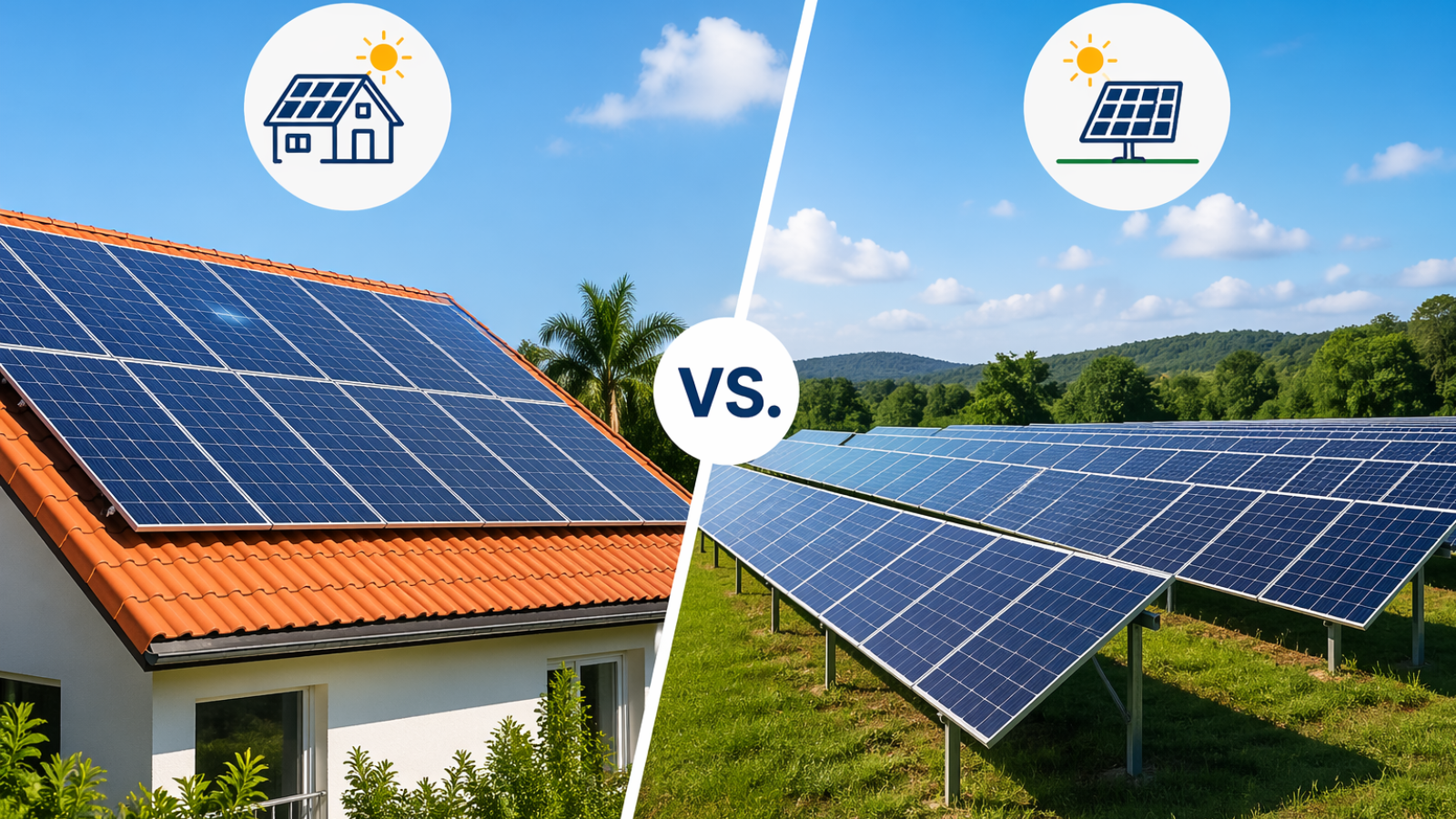
A rooftop solar system is mounted directly on the existing roof of your factory, warehouse, or commercial building. A ground-mounted system is installed on open land adjacent to or near your facility, with a dedicated structural frame embedded in the ground.
Neither is universally better. What matters is which one best fits your site, energy load, and long-term goals. Let’s break that down.
Rooftop Solar for Industries: The Case for Going Up
For most industrial facilities in urban or semi-urban India, think factory sheds in MIDC zones, warehouses on the outskirts of Mumbai, or manufacturing units in Pune or Thane, rooftop solar is the natural first option. And for good reason.
You’re Using Space You Already Own
The roof is often the largest unused real estate in an industrial unit. A standard factory shed with a 2,000 to 5,000 sq. ft. roof can comfortably accommodate anywhere from 50 kW to 200 kW of solar capacity, depending on the roof type and load-bearing structure. That capacity directly offsets your daytime consumption, with no additional land acquisition required.
Lower Civil Work, Faster Installation
Rooftop systems generally involve less structural groundwork. There’s no land clearing, no deep foundation work, and no fencing requirement. For industries that want to go solar quickly and efficiently, rooftop installations typically have shorter timelines, sometimes commissioning within 4 to 8 weeks for a well-assessed site.
Grid Connectivity Is Simpler
Because the solar system is on the same structure as your facility, connecting it to your internal distribution board and the DISCOM metering point is more straightforward. This usually means lower BOS (Balance of System) costs and simpler net- or gross-metering arrangements.
Where Rooftop Solar Has Limitations
Here’s where things get interesting. Rooftop solar is constrained by the physical reality of your roof. If your roof is old, asbestos-lined, or structurally weak, it either needs reinforcement or may not be suitable at all. Shading from adjacent structures, rooftop equipment like HVAC units or water tanks, and non-ideal roof orientation can also reduce system performance.
More importantly, if your industry has a large energy load, say, a 24-hour manufacturing facility consuming 500 kW or more, your roof alone may simply not have enough area to meet most of that demand. That’s where ground-mounted solar enters the picture.
Ground-Mounted Solar for Industries: When the Roof Isn’t Enough
Ground-mounted solar systems are typically considered by industries that have one or more of the following: high energy requirements, available open land, or site conditions that make rooftop installation impractical.
No Roof Constraints, Maximum Design Flexibility
With a ground-mounted system, the panels can be optimally tilted and oriented for maximum energy harvest, typically facing south at an angle of 10° to 25° for Indian latitudes. There’s no compromise based on the existing roof angle. This translates directly to higher per-panel output over the year.
At Visol India, when we conduct site feasibility assessments for large industrial clients, we often find that a well-designed ground-mounted system in Maharashtra generates 8–10% more annual energy than a rooftop system of the same capacity, simply because of optimised tilt and the absence of shading losses.
Easier Maintenance Access
O&M (Operations & Maintenance) is a critical but often underestimated factor in solar plant performance. Ground-mounted systems are significantly easier to clean, inspect, and service. There’s no need to send technicians onto a roof, no risk associated with working at height, and cleaning equipment can be deployed at ground level efficiently. Over a 25-year plant life, this matters more than most buyers realise at the time of purchase.
Scale Without Compromise
Industries looking at MW-scale solar capacity, steel processors, large textile units, cold chain logistics facilities, and food processing plants will almost always need ground-mounted installations, either on-site or through a third-party land arrangement. Rooftop simply cannot scale to that level.
The Land Question
The obvious consideration with ground-mounted solar is land. You either need to own it, lease it, or arrange for it nearby. In densely industrialised areas like Mumbai’s suburbs, available land near your facility may be scarce or expensive. This is a practical constraint that needs an honest evaluation up front, not after you’ve decided on the system type.
Side-by-Side Comparison: What Matters to Industrial Buyers
| Factor | Rooftop Solar | Ground-Mounted Solar |
| Space requirement | Uses existing roof | Requires open land |
| Installation time | 4–8 weeks (typical) | 8–16 weeks (larger systems) |
| Energy optimisation | Constrained by the roof angle | Fully optimisable tilt/orientation |
| Maintenance ease | Moderate (working at height) | High (ground-level access) |
| Scalability | Limited by the roof area | Virtually unlimited |
| Civil/structural cost | Lower | Higher (foundation, fencing) |
| Ideal for | SMEs, urban industries, warehouses | Large-scale manufacturers, agro industries |
So Which One Should You Choose?
The honest answer: it depends on a site assessment, not a general recommendation.
What most people don’t realise is that many industries adopt a hybrid approach. Rooftop solar covers the available shed area, and a small ground-mounted array on unused yard space handles the remaining load. This is actually quite common in manufacturing units we’ve worked with; it allows a business to maximise self-consumption while keeping the system design practical and cost-effective.
A few questions worth answering before you decide:
- What is your average monthly energy consumption (in kWh or units)?
- What is the available roof area, and what is its structural condition?
- Do you have any open land within or adjacent to your facility?
- Is your energy consumption highest during daytime production hours?
- Are you looking to cover 30–50% of your load, or aiming for near-zero grid dependency?
These aren’t questions you should be guessing at. They form the foundation of a proper solar feasibility study, and they’re exactly what a professional solar EPC company should do before recommending anything to you.
One More Thing: The Financial Model Matters Too
Regardless of whether you go rooftop or ground-mounted, the financial model you choose will significantly shape your ROI and cash flow profile.
Under the CAPEX model, you own the system outright. The capital investment is yours, the depreciation benefits (including accelerated depreciation under the Income Tax Act) are yours, and so is 100% of the long-term savings. Payback periods for industrial solar in India currently range from 3.5 to 5.5 years, with system life well beyond 25 years.
Under the OPEX model (also called PPA or third-party ownership), you pay zero upfront. A developer funds, installs, and owns the plant. You simply buy solar energy at a rate lower than the grid tariff, often 15–30% lower, from day one. There’s no capital at risk, and the savings are immediate.
The right model depends on your balance sheet, tax position, and risk appetite. Both are legitimate paths to meaningful reductions in electricity costs.
The Right Decision Starts With the Right Assessment
Choosing between rooftop and ground-mounted solar shouldn’t be based on a brochure or a general blog post, including this one. Every industrial site has unique characteristics that affect which approach will deliver the best outcome.
At Visol India, every project starts with a free, no-obligation site feasibility study. Our team assesses your roof structure, energy consumption pattern, available land, grid connectivity, and financial goals before recommending a system design. That’s how we’ve maintained a 99% client satisfaction rate across 50+ installations.
If you’re evaluating solar for your facility, whether it’s a small factory in Thane or a large manufacturing plant across Maharashtra, the smartest first step is a conversation. Not a commitment.
Get in touch with Visol India to schedule your free site feasibility today.
Recommended Posts
How Solar Reduces Your Fixed Electricity Tariff: A Cost Breakdown for Factory Owners
19th September 2026
Solar ROI Calculator Explained: How to Read Your Payback Period and IRR
19th September 2026